The Grief We Don’t Name
Why Organizational Change Is Also a Process of Mourning
In the world of leadership and organizational development, we talk a great deal about “change management.” But what we often fail to talk about is the grief that accompanies that change. The truth is, every organizational shift is not just a strategic transition but also a psychological process. Which includes mourning the old ways, the old identities, and the relationships that were tied to “how things used to be.”
As leaders, we often find ourselves managing what appears to be resistance or disengagement. Yet, what we may actually be seeing is unacknowledged grief; people mourning the loss of a familiar project, a trusted colleague who’s moved on, or simply the comfort of the known.
The Hidden Layer of Organizational Change: Loss and Transition
Change, as William Bridges teaches us, is external. But transition is the internal, psychological process people go through to come to terms with that change. It’s not just about new structures or strategies; it’s about letting go of what was. And that letting go often follows a pattern that looks a lot like grief: denial, anger, bargaining, sadness, and finally acceptance.
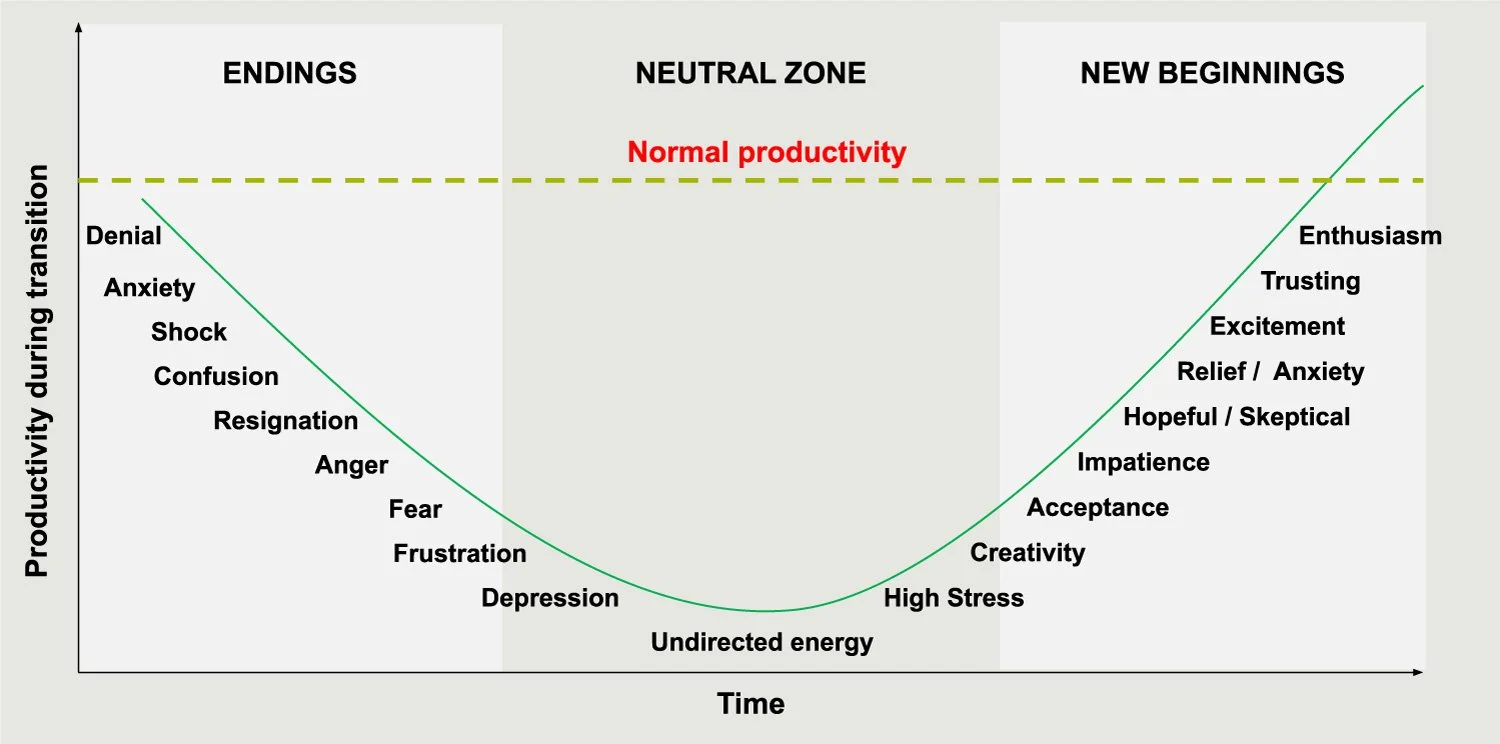
The William Bridges Transition Curve is a well-established way of looking at how individuals experience change through three distinct stages: Endings: letting go of the current state, The Neutral Zone: figuring out what our new normal could look like, and New Beginnings: adopting new routines and behaviours.
What Leaders Misinterpret as Resistance Is Often Unspoken Grief
When a team seems disengaged after a major change, we might be seeing the signs of what some scholars call “disenfranchised grief.” It’s a type of grief that isn’t openly acknowledged or validated because it’s not about a death, but about the loss of something deeply meaningful. It might be the end of a long-standing project, a shift in company culture, or the departure of a beloved leader. People are not just resisting change; they are mourning something they valued.
How Leaders Can Become Grief Sensitive
So what does it mean for a leader to be grief sensitive? It means acknowledging that change is not just about new plans, but about creating space for people to let go of the old ones. It means holding space for conversations where team members can share their feelings of loss, offering rituals of closure for what’s ending, and helping people make meaning of the transition.

At NiaDelta, we’ve seen the power of this approach in our work with leaders and organizations. For instance, our work in Team Retreats and Re-Onboarding experiences have taught us that when teams have a chance to surface their unspoken fears or grief about change, they emerge more aligned and ready to embrace the future. We have also helped organisations think about how to build intentional rituals for change, such as creating farewell rituals for when people transition out of an organization or sense-making-sessions so that people can share what they are really processing and feel fully heard.
Practical Steps for Leaders: A Grief-Informed Change Model
Leaders can start by asking themselves and their teams a few key questions: What are we losing? What identities are changing? Where might grief be hiding? And how can we create moments to honor what was before we fully embrace what will be?
By adopting a grief-informed approach to change, leaders become not just managers of transition but stewards of the human heart of their organizations. They help their teams not just to adapt, but to heal and find new meaning. And in doing so, they lay the foundation for a more resilient, more engaged, and ultimately more flourishing organization.